
Most people understand why they should recycle. Done properly, it saves energy, resources and reduces the amount of waste sent to landfill.
All UK local authorities now have a duty under the Environmental Protection Act 1990 to collect waste. Also EU and UK laws and other regional laws and policies from the National Assembly for Wales, the Scottish Parliament and Northern Ireland Assembly provide recycling targets for local authorities.
Something like 50% of what goes in your bin should be easily recyclable. What local authorities recycle depends on the facilities in the local area and vary from region to region. Here is a list of things you shouldn’t put in your recycle bin and what to do with them:
Things you shouldn’t put in your recycle bin
#1 Pizza boxes 
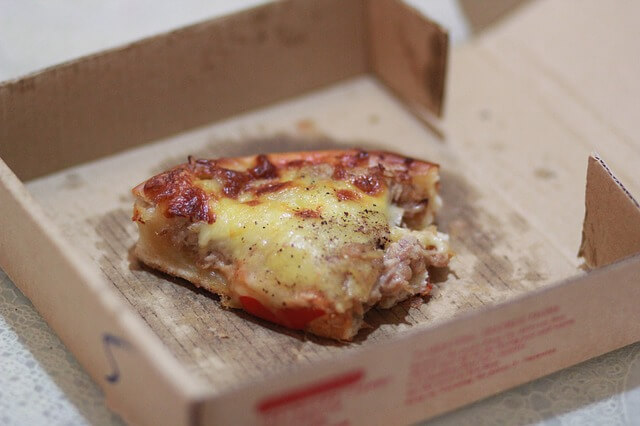
They are made of cardboard which should be recyclable. Unfortunately if it is stained with grease or food it can’t be recycled. In fact any grease contaminated paper, including baking paper, can’t be recycled.
#2 Crisp packets
These are metallised plastic and are not recyclable. The scrunch test will confirm whether something is recyclable foil or not. (scrunch the item into a ball, if it stays then it is foil, if it springs back then it is a metallised plastic film and not recyclable.)
#3 Glittery or metallic wrapping paper
Again, the scrunch test is your friend when disposing of gift wrapping, and don’t put the ribbons in there either.
#4 Tissue and kitchen roll
The cardboard tube is recyclable, but not the soiled tissue or sheets.
#5 Wallpaper/paintings
Recyclable paper cannot be paint-stained, and the colouring used on wallpaper means it can’t go into the recycling bin.
#6 Wet wipes Wet wipes, baby wipes, cosmetic wipes
They’re not recyclable and they’re not flushable either, whatever the packaging claims. You should put them in the rubbish bin.
#7 Polystyrene
This should not go in your recycling bin, although your council might accept it at a recycling centre.
#8 Light bulbs
They’re a different glass to your jars and bottles, plus they contain metal. You can take energy efficient bulbs to most recycling centres, and the old style incandescent ones can go in the rubbish bin.
#9 Batteries
Don’t put your old batteries in the bin as they contain harmful metals that can seep into soil and water when put into landfill. Either save them up and take them to the local recycling centre for specialist disposal or many shops should offer a take-back scheme it sells more than 32 kg of batteries per year (https://www.gov.uk/battery-waste-supplier-reponsibilities).
#10 Broken glass
It’s recyclable, but dangerous, so don’t put it in your wheelie bin. If you can handle it safely, you can take it to a recycling centre but you may need to wrap it in newspaper and put it in the rubbish bin.
#11 Single use coffee cups
The plastic lid and cardboard sleeve is recyclable, but the coffee isn’t. It’s made from card lined with heat resistant polythene. This is a composite material that is difficult to separate so can’t be recycled easily. This is the subject of an ongoing campaign by Hugh Fernley-Whittingstall amongst others – see Hugh’s war on waste – lifting the lid off the landfilled coffee cups scandal
#12 Plastic straws
Although plastic straws are made from recyclable propylene they are difficult to sort and separate on the conveyor belt in recycling centres. They invariably end up going to land fill.
#13 Garden waste
Green garden waste such as grass clippings or dead leaves should be composted. Composting bins are cheap and very easy to get going.
#14 Food waste
Many local authorities take food waste and send them it to specialist facilities. There they make fertiliser using a process called in-vessel composting or anaerobic digestion which makes fertiliser and methane as Biogas. (see https://www.foodwastenetwork.org.uk/content.html?contentid=12)


#15 Plastic bags
Some supermarkets are offering plastic bag recycling schemes, but plastic bags, plastic food packaging and other plastic film cannot be recycled. The 5p plastic bag charge had a dramatic effect on cutting plastic bag usage, but we should all be using reusable bags. Unfortunately online groceries are still packing purchases in plastic bags.
Recycling shouldn’t be too much of a burden. If you have children they are often very interested and motivated to recycle more and it’s often very educational to find out about where materials come from and their disposal or reuse.
Your local authority will be happy to answer any questions about recycling.
Useful links and further reading
What’s so bad about plastic straws for recycling
Pizza boxes etc what you shouldn’t put in your recycle bin