
An accusation frequently hurled at renewable energy sources like Wind and Solar is the number of birds they kill.
It seems that climate change deniers like Rupert Murdoch and Donald Trump suddenly have damascene type conversion to fighting for the environment when they criticise wind and solar for killing birds. In 2012 Murdoch tweeted that wind turbines are “uneconomic ugly bird killing windmills.”
Donald Trump in his usual rambling style is a regular critic of wind power:
“[Wind power] kills all the birds,” Trump told 2012 Republican presidential candidate Herman Cain on the latter’s radio show Tuesday. “Thousands of birds are lying on the ground. And the eagle. You know, certain parts of California — they’ve killed so many eagles. You know, they put you in jail if you kill an eagle. And yet these windmills [kill] them by the hundreds.”
Forgive us for being cynical about someone who has previously shown no interest in environmental protection but he and his best friend Donald Trump are wrong to focus on renewables when the coal industry is by far the biggest killer of birds.
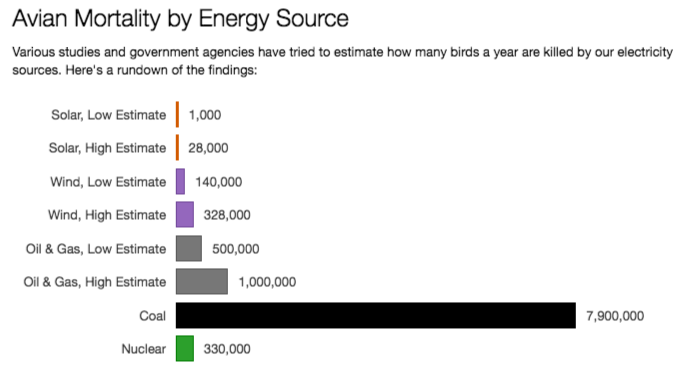
Best estimates show that Coal kills nearly 8 million birds a year in the states, compared to 300,000 by wind and an upper estimate of 28,000 by solar. Any unnecessary animal death are regrettable but if we want power then there will be far fewer deaths from renewables.
So if as Donald Trump has promised, he brings back the US coal industry, he will end up killing many more of his beloved birds.

How does the coal industry kill birds?
1. Habitat destruction
Coal extraction requires significant land clearance. This begins by clear-cutting and burning forests. Then, in order to reach underground coal seams, miners must remove huge amounts of soil and rock; destroying wildlife habitat. One particularly destructive form of surface mining, called mountaintop removal, literally involves blasting apart the top of a mountain and pushing the soil and rock into nearby valleys.
2. Air pollution
Emissions from coal-fired power plants are the leading source of smog, acid rain, and toxic air pollution. Sulfur dioxide, nitrogen oxides, particulate matter, mercury, carbon monoxide, and arsenic are just a few of the harmful pollutants emitted by coal plants on a daily basis. These pollutants cause a variety of respiratory and cardiovascular diseases that impact not only humans, but wildlife as well.
3. Coal ash spills
Coal ash is the toxic waste generated by coal-burning power plants. This toxic sludge can be stored in coal ash ponds that are too often improperly safeguarded against leaks and breaches. This negligence has resulted in numerous spills that have devastated natural wildlife habitat.
4. Water pollution
Coal mining impacts aquatic wildlife in several ways. As noted above, both mountaintop removal and coal ash spills can result in harmful pollutants entering our waterways. Coal-fired power plants are also responsible for dumping millions of tons of toxic metals into our surface water each year.
5. Coal dust
The dust created by the crushing and processing of coal causes a host of problems for wildlife. In addition to potentially severe heart and respiratory problems, coal dust can impair the ability of leaves to photosynthesize and oxidizing coal particles can settle in waterways, reducing the oxygen available for aquatic wildlife.
6. Mercury deposition
Coal-fired power plants are the largest source of toxic mercury contamination in the United States. Fish are particularly susceptible to mercury poisoning, but scientists have also found mercury accumulation in birds, mammals, reptiles, and amphibians. The primary consequences of mercury poisoning are reproductive and neurological problems.
7. Climate change
Lastly, coal-fired power plants are a leading source of CO2 and other greenhouse gas emissions. If we don’t curb these emissions, climate change has the potential to significantly alter ecosystems and cause mass species extinctions. From rising ocean temperatures to more frequent natural disasters, climate change is already impacting wildlife. Scientists have learned that some species are having difficulty adapting or moving fast enough to more suitable areas.
Further reading
http://politicalgates.blogspot.com/2012/04/earth-day-rupert-murdoch-takes-to.html
https://thinkprogress.org/donald-trump-wind-kills-all-the-eagles-bd4acf3264d#.o74fzbvo9